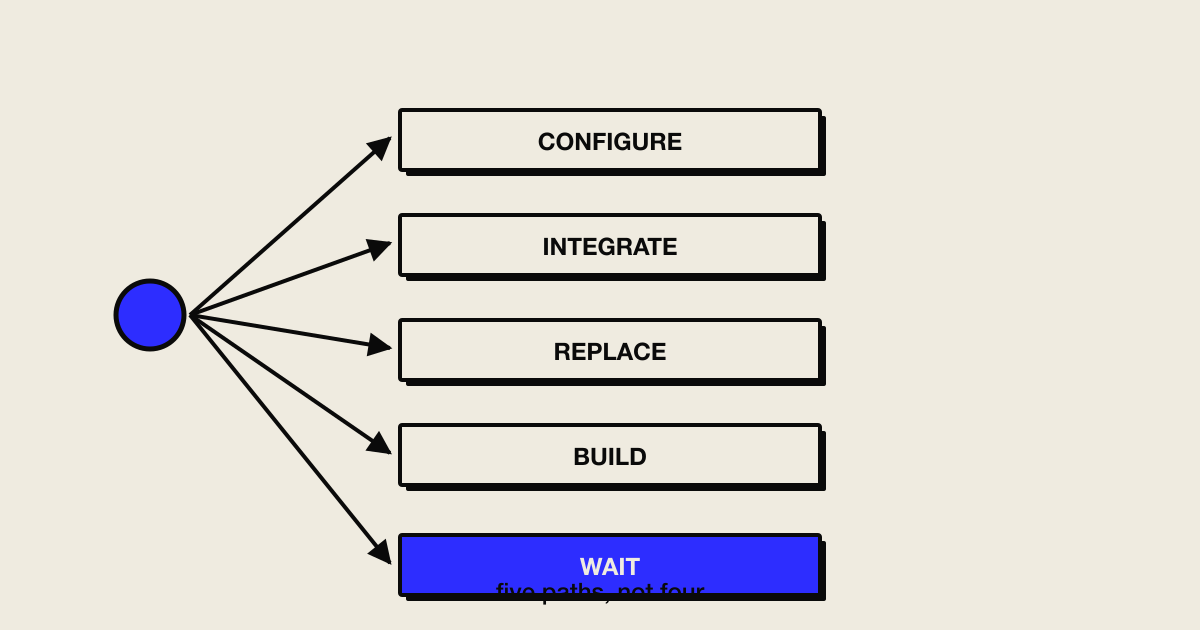
Most owners never face a clean build-or-buy choice.
When something stops fitting - orders need three re-entries, reports require a spreadsheet on the side, permissions don’t match how approval actually works - there are five defensible responses. You can reconfigure what you already have. You can integrate tools so they talk to each other. You can replace one product with another. You can commission something built for the way you actually operate. Or you can decide, deliberately, that now is not the moment and wait until the cost of being wrong is high enough to justify the spend.
The useful question is not “should we build?” It is “which intervention fits this workflow, this team, and this moment.”
This guide gives you the framing Garaxe uses with our own clients - six questions, one matrix, two worked scenarios, and the failure mode each path carries when it is chosen for the wrong reasons. We state it as how we frame it, not as an industry standard. If your situation is genuinely different, the matrix should tell you so.
The usual question misleads because it omits two cheaper answers and one honest one
Read the top results that rank for this decision and a pattern appears quickly.
Most advice frames the choice as build versus buy, or at most build / buy / buy-and-extend. The authors often have a stake in one answer. A SaaS vendor argues “buy.” A SaaS-management vendor argues “buy and govern.” A form-builder or AI-tool vendor argues “build with us.” An integrator argues “integrate.” The comparison tables inside those guides assume there is an internal engineering function to absorb ownership once something is built - and that the two missing options, reconfiguration and replacement, have already been ruled out.
That frame serves companies with IT teams. It fits owner-operated businesses less well, for three reasons:
First, configuration and integration are often the whole answer. When the data shape is right but the fields are wrong, or when two products you like simply don’t exchange data, the fix is cheaper than either buying something new or commissioning a build. None of the enterprise scorecards Garaxe reviewed on 2026-08-21 treated configuration as a scored option; one sharp snippet - “buy when common, integrate when the gap sits between systems you already own” - captured the distinction, but the page itself was unavailable to verify.
Second, replacement is its own decision, not a variant of buying. Replacing a system that was mis-bought in the first place is different operationally and commercially from adopting a first product. The migration, Parallel checks, and retraining that replacement requires never appear in a generic build-vs-buy comparison. For owners already mid-tool, replacement is the most common alternative to building, not browsing a green-field catalogue.
Third, waiting is a real strategy. Owners carry more consequences of a wrong commitment than an advice-giver does. When the workflow is still settling, when a hire will change how work flows, or simply when the business’s shape is about to shift, choosing nothing yet while removing the most painful workaround is defensible. No live result Garaxe reviewed scored “wait” as an outcome - the closest was “buy” - which is why owners who are not ready often feel pressured into buying something.
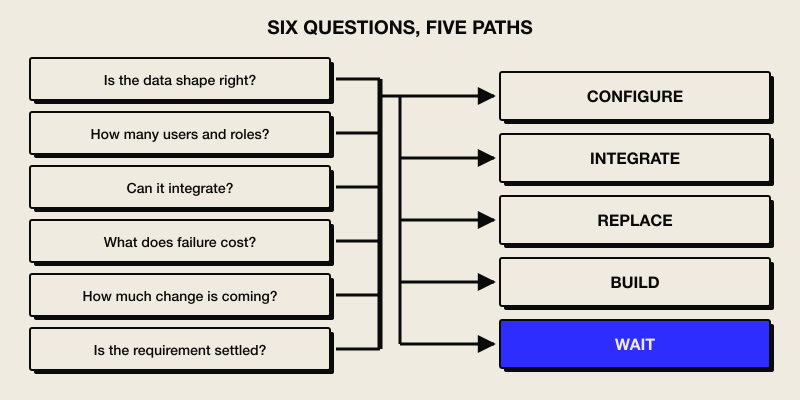
This page scores all five.
The six questions
Answer these honestly for the workflow under discussion - not for the company as a whole. Mark each high, medium, or low for your situation; the matrix that follows maps the combination.
1. Is the workflow core, or is it commodity?
Core means the way you do this work is part of why clients choose you over a competitor - the pricing logic, the routing, the last-mile coordination that nobody’s SaaS product already models well. Commodity means thousands of businesses do it the same way - invoicing, payroll, standard lead tracking - and mature products have already encoded best practice into their defaults. Core points away from commodity SaaS; commodity points firmly toward it.
2. How settled is the requirement?
If you can walk through the workflow end-to-end - inputs, exceptions, approvals, who decides what - you can describe it to someone else. If you are still discovering what “done” looks like, any commitment now bakes in today’s half-formed assumptions. Unsettled requirements reward time inside a tool you can learn from, not a build you cannot yet specify.
3. How many roles and permissions does the work actually need?
Two people using one sheet is one problem. Twenty people with different approval gates across three locations is another. The number of roles predicts configuration pain more reliably than the number of records does. SaaS configuration scales quickly to a point, then suddenly doesn’t; the inflection is usually at permission boundaries, not at data volume.
4. How dense is the integration surface?
One system in standalone use is a configuration question. Two or three systems that must agree on the same client, job, or invoice is an integration question. Four or more systems exchanging data in real time is where “integrate” and “replace” diverge from “build” - and where the ownership cost of the plumbing itself becomes material.
5. What does failure cost?
Entered-once-and-recovered failure is different from regulatory, financial, or client-facing failure. GDPR-relevant data handling, money movement, safety implications, and audit-trail obligations (FCA, CQC, SRA-style reasoning for regulated contexts) weigh heavily toward products that already carry that burden - or toward builds scoped explicitly around that boundary. Low regulatory cost widens the space where a small build is reasonable.
6. How stable will this be over the next three years?
If the workflow will look materially different in a year - a new service line, a restructure, a market shift - optionality is worth more than fit. If the workflow is stable and you will live with the consequences of the choice for years, fit is worth more than optionality. Teams underrate this question because change is easy to imagine and easy to forget when choosing a tool.
Reading the matrix: which combination points to which path
Self-contained and worth saving. Work through the six questions above, then read the row that describes your situation.
| Situation pattern | Default path | Before committing, also check |
|---|---|---|
| Common work, unsettled need, few roles, single system, low failure cost, expects change | Wait or configure lightly | Whether short-term learning inside the current tool is enough - buying or building now locks in assumptions that will break in months |
| Common work, settled need, 1–2 systems, low failure cost | Buy (configure) | Which vendor covers your workflow’s last 10% without heavy customization |
| Differentiated work inside a common workflow, 2–3 systems, medium failure cost | Integrate | Pick best-in-class products per domain (finance, CRM, operations) and build the narrow plumbing layer Garaxe is candid about: documented, monitored, owned - not invisible wiring |
| Common work on a wrong product - chronic configuration debt, wrong data model | Replace | Migration: source of truth, data mapping, parallel checks, fallback, rollout authority |
| Genuinely unique work, settled and stable, 3–4+ systems or high failure cost, and you have the capacity to own the result | Build (or buy-and-extend if 80% of a platform already fits) | Whether an 80/20 split - stable platform plus a focused custom layer - preserves vendor roadmaps while closing exactly the structural gap |
| Unique need but small team, unsettled requirements, or no one to own the result | Defer building - integrate or wait first | Who owns the build for the next three years if the person commissioning it leaves |
The sixth question is the tie-breaker when a situation scores between two rows. When stability is low, wait. When stability is high, fit wins.
Two worked scenarios (illustrative)
These are bounded examples to show how the matrix reads in practice - not client claims.
A 12-person logistics firm drowning in spreadsheets
Fifteen customers, forty jobs a week, bookings tracked in a shared sheet, invoices typed by hand from the same sheet, drivers confirmed by phone.
- Core vs commodity: Mixed. Transport itself is differentiated; quoting, booking, invoicing are commodity.
- Requirement maturity: Settled - the firm has done this for two years and can walk through every step.
- Roles: Small - owner, dispatcher, drivers. Permission boundaries are modest.
- Integration surface: Two systems wanting to be one: the sheet and the invoicing app.
- Failure cost: Low regulatory risk; real operational cost when a job is missed.
- Change over three years: Stable shape - the next year is more volume, not a different business.
Matrix points to integrate: keep the invoicing product the accountant already trusts, add a narrow built layer that turns a booking into a job and an invoice without re-typing. Replacement would re-teach the accountant a new product for no gain; a full build would create an orphan the owner cannot staff.
A 30-person agency whose CRM fights its pricing model
Retainers with staged deliverables, bespoke pricing per client, approvals that cross finance and delivery. The off-the-shelf CRM advertises flexibility but requires a plug-in for every pricing variant - each one configured with a different vocabulary.
- Core vs commodity: The pricing and delivery model is the differentiator. Standard pipeline tracking is commodity.
- Requirement maturity: Settled - the agency knows its model deeply.
- Roles: Meaningful - client leads, finance, delivery, owners. Permissions are substantive.
- Integration surface: Three systems (CRM, finance, resource planning) that disagree on what a “project” is.
- Failure cost: Money and client trust when pricing is wrong; no heavy regulatory burden.
- Change over three years: Stable model; more clients and more variants, not a different shape.
Matrix points to build-or-extend, weighted toward extend: keep one stable CRM and one finance product for their commodity parts and their vendor roadmaps; build exactly the pricing-and-delivery layer where the business is not generic. Configuration alone has been tried and produced the plug-in sprawl in the first place. A pure build of the whole stack would discard useful products.
How each path fails
Understanding failure before choosing is cheaper than understanding it after.
Configure fails as configuration debt. Layer after layer of workarounds - custom fields, hidden automations, add-ons - until the business is reshaped to fit the tool. The sign is language drift: your team’s vocabulary starts to match the tool’s rather than the client’s.
Integrate fails as integration sprawl. Undocumented webhooks, a Zapier account shared with former staff, an overnight sync with no monitoring and no owner. The plumbing itself becomes the fragile thing everyone is afraid to touch. Garaxe’s standing position is: treat any integration layer as a product - documented, monitored, with an owner - or it quietly becomes the most expensive part of the system.
Replace fails as churn. The same work moved into a new product with the same unsettled requirements, or with migration handled as “export and hope.” Owners pay the learning cost twice and inherit new blind spots. The antidote is migration discipline that rarely appears in marketing copy: uninterrupted source of truth, explicit data mapping, parallel runs with reconciled numbers, a named fallback, and a rollout that respects that people need to learn.
Build fails as orphanhood. Something bespoke arrives, the person who championed it moves on, and nobody remains who can change it safely. A build is only as durable as the plan for who maintains it - documentation, repository and deployment access, test coverage proportionate to failure cost, and a named person or accountable partner for the next three years.
Wait fails as drift. Workarounds calcify, spreadsheet logic spreads, and the business normalizes a cost that has become material. Garaxe’s test for “waited too long” is direct: when the same workaround recurs every week, when reports cannot be trusted without reconciliation, or when onboarding a new person requires learning a shadow process, the cost of deciding incorrectly has been outweighed by the cost of deciding nothing.
What to do after you choose
Each path has one accountable next step. Treat that step as part of this decision.
- Configure - document the intended workflow before touching the tool. Scope configuration as one complete business path, not as scattered fields.
- Integrate - commission the plumbing with the same seriousness as the product: error handling, retries, logging, monitoring, and who is paged when it breaks. If you use Garaxe, this is the layer we design and operate for owners who do not want to own the stack.
- Replace - agree the migration plan first: what happens on cutover day, who decides to roll back, and what evidence settles whether the replacement is correct.
- Build - turn the same content into a brief. The companion piece on how to brief a developer without writing a technical specification covers that exact document - outcome, users, current process, exceptions, data, constraints, first result - and is the natural next read if this matrix lands on build.
- Wait - make waiting active. Remove the sharpest workaround and make the trigger for revisiting explicit: “we revisit this when we reach X volume or when Y report fails its reconciliation.”
For ownership and exit-readiness - what you must actually own regardless of who builds the work - the cluster’s closing pieces on code, data, access, and the vendor exit plan are written to protect the buyer even when Garaxe is not the vendor.
FAQ
Can I just keep configuring what we have? Often. When the tool is fundamentally right but the setup is wrong - fields are missing, permissions are loose, or steps are manual that should be automatic - reconfiguration is faster and cheaper than any other path. The signal to stop configuring is when you are reshaping the business to fit the tool. At the point where vocabulary, reporting, and approvals twist around the product’s assumptions, the product is no longer configuring to you.
When is building clearly wrong? When the workflow is a commodity (invoicing, payroll, standard CRM), when you cannot yet describe the requirement precisely, when a small team would inherit an orphan nobody is accountable for, or when you need it live in days and can buy something that covers 90% of the job. Another signal: if the “unique” part of your workflow disappears when you write it down, it may be experiential complexity, not structural difference.
What does “integrate” actually involve for a non-technical owner? Connecting tools you already trust so data flows without re-keying - typically quotes into invoices, deals into operations, or systems into one reporting view. The work is plumbing and error handling, not a new product. For an owner, the deliverable is time saved weekly plus one place where the numbers reconcile. The discipline is governance: documented flows, visible monitoring, an owner, and the ability to change one end without rebuilding the whole thing.
How do I know I’m waiting too long? When the same workarounds recur every week, when report numbers cannot be trusted without reconciliation, or when new hires need a week to learn the shadow process. If the business has materially changed since the last time you ran these six questions, re-run them. Stale decisions carry hidden costs that rarely appear on an invoice.
Notes
- Live result set retrieved 2026-08-21 (en, GB proxy, Content Research API
req_2eb129c1fdc5+req_1cbe62c02a57,budget_usd: 0; autocomplete returned no suggestions on both seeds). Result pages opened and read: zylo.com, agileoperations.co.uk, and fillout.com. A fourth top result (parameterllc.com) returned HTTP 520 and could only be verified as a snippet. Semantic neighbours cited in research but not presented here as authoritative claims. No AI-answer baseline was collectable this session (llm_probeunhealthy) - the inference that assistants reproduce the vendor-skewed three-path frame is labelled as such in the research package and not repeated as fact here. - Re-verified 2026-08-24 (request
req_4d2cc986b9bd, zero budget) because eight of the nine other pieces in this programme had their differentiation claims refuted on re-check. Three further pages were opened. The two substantive claims held: no opened page supplies a decision matrix across all four paths that an owner can use, and not one of six pages opened across both dates scores waiting as a legitimate outcome. One correction: a four-path framework aimed at owner-operators does now exist (Keep, Connect, Replace, Build), so the four-path structure is not ours - what is ours is the scored matrix, the tie-breakers, the failure costs, and treating wait as a path. - No client project, outcome, volume, or sector figure is presented as a case. The worked scenarios are labelled illustrative; the matrix is Garaxe’s practitioner framing.
Not sure which path fits your situation?
Tell us how the work actually happens today - we'll help you pick the intervention that earns its cost.
Talk to Garaxe about the problemRelated Articles
Scoping a First Version: What Decision Will It Produce?
Three of the four parts are standard advice. The fourth - the decision your first version produces - is what stops you building a tidy fragment.
small business toolsWhat Each Blank in Your Software Brief Costs You
The seven-part structure is freely available. What no one prices is each blank - so here is what a missing part does to the number you get back.
small business toolsThe Signs Are Real. They Won't Tell You What to Do.
Five problems produce the same symptoms, and four are cheaper to fix than the one most people assume. Naming the cause tells you what it justifies.
Ves Ivanov
Co-founder, Garaxe
Building practical tools for small businesses. Focused on Voice of Customer analysis and actionable marketing insights.